Monday, June 29, 2015

Computer Guru And Cupcake Godsend

In The Panhandle And In The Basement

Since the development of photography, a subsequent, disheartening phenomenon has followed: losing one’s photos.  I’d wager this frustration first began when David Bachrach barely managed to snap a blurry shot of the sixteenth President before he finished invoking his forefathers four score and seven years prior.  Perhaps we humans thought such irritation at our inability to capture and preserve moments for our family’s posterity when the modern era converted from film to digital images.  Wrong.  A mere handful of days into my vacation, when I had strategically and deliberately saved each day’s photos to my computer to preserve coveted space on my SD card, my device unexpectedly succumbed to the crashing catastrophe of digital proportions and failed to preserve the images of my experiences to date.  Curses!  I practically can hear the shock of the photographer at Gettysburg as Lincoln takes his seat.

Surprisingly, in the quaint town of Coeur d’Alene, after coping with my mildly horrific loss for twenty-four hours, I wander past the lower level of what used to be city hall.  To my joy and delight, I spy the timely establishment of the Computer Guru, and return to fetch my ailing laptop.  Hope springs anew, but the sad truth remains that my photos will not be salvageable.  I begin to accept the fate of the lost images, and I sadly contemplate how best to drown my sorrows.  Thankfully, the adorable hamlet into which I have stumbled provides an immediate cure.  Sharing office space in the basement of the Old City Hall, a cupcake shop beckons me to release my virtual defeat and accept the solace of the moment with a bit of Guinness and chocolate baked into a paper-lined, over-sized, sweetly-frosted remedy for what ails my computer.  I acquiesce.

Of, By, And For

I accept my defeat.  I move forward.  I will let me laptop be held in repose until my return from my vacation and then I will find a solution to breathe life into its monitor.  Now that I am home, I find myself starting from scratch, hoping to be struck by lightning and illuminated into finding a computer repair source that provides me with comfort that sometimes bad things happen to good machines.  I flounder unsuccessfully, wistfully wallowing in the loss of my digital accomplice (see “My Muse” from December 2012).  Were I to find a golden pot of surprises at the end of the computer-repair rainbow, a specialty shop that could restore my faith in electronics, as well as restore my hard drive, would it ever equal the sweet magic of a computer guru juxtaposed in a cozy corner with cupcakes?  Doubtful.

Why reinvent the wheel?  Why struggle in my search for netbook nirvana when I have already identified a cosmic corner where cupcakes and computers live harmoniously adjacent to one another?  I pack my lifeless electronics into bubble wrap, hoping it will arrive at its destination, forty-seven states away from me, with enough functioning bits and pieces to be restored to its previous glory.  I do not worry needlessly.   I know my computer, once safely at its destination, will be embraced in capable hands.  That Ray, as I affectionately dub my laptop, will arrive in a familiar setting, will begin to heal to its pre-vacation stature, and that if all else fails, it will rest in peace next to the sweet smell of cupcakes.  I solemnly believe that the Computer Guru of the Panhandle, by the cupcake shop, and for the sake of my laptop, shall not perish in its efforts.

Monday, June 22, 2015

Hazy Shade Of Summer

Not A Cloud In The Sky

After discovering the secret about Jacob’s Lake (see “Jacob Lake” from January 2012), our Plan B excursion brought us to the base of the identically named Lookout Tower.  I didn’t ascend it.  Only Son #1 tackled those stairs, as I remained grounded with Son #2 (with a note to myself to go back and do that) peering upward wondering what the view must encompass.  Even from the dull seats eighty feet below, the history of the structure tickles me.  Yet again, the Civilian Conservation Corps strikes.  More than eight thousand feet above sea level, the most noteworthy quality of its height remains today, as it did in 1934 when its construction was completed, to peer across the tree tops to scout for blazes beginning in the Kaibab National Forest.

Before aircraft skimmed the skies, the eagle-eyes of the solitary individuals perched in their tower detected the first signals of smoke and then provided coordinates to those charged with its extinguishment.  The same service remains today, aided by technology, but still dependent on the eyes of the individual up in the tower.  On the day my son ascended, the clear horizon brought no urgency, sounded no alarm, and the forest slept soundly.  The view up there may have been spectacular, but the outlook at the lookout appeared dull.

Not A Sky In The Clouds

Even the sun appears a sickly shade of scintillation, covered thickly by the smoke from the Washington State fires.  For a record number of days, Seattle measures no rain, no storms pummel Puget Sound, and nearly hidden in plain sight, Mount Rainier cloaks itself in an ominous haze (see “Change of Plans,” December 2013).  The signs of smoke reach from the eastern mountains to the western shore, hovering over the city, threatening its usual summer glow, reminding me that the fire crews at our hotel in Omak wish fishing on the Columbia and sightseeing hydroelectric dams filled their days outdoors.

How different one season to the next might affect the view of the Pacific Northwest.  How tranquil a forest might be in a moist year and how devastated it may become in another.  Looking across the crystal blue sky in Northern Arizona appears in such contrast to the streaks of brown hovering between me and the light of the afternoon, planet Earth altering its best vistas into dingy, haunting reminders of its fragility.  Somewhere above the clouds of ash and smoky haze, the sky desperately attempts to peek down upon me and while I know it stretches high above me, I wonder when I might see it again.  All signs point to a long wait.

Thursday, February 26, 2015

Five Routes Coming and Going

Yellowstone Part 1

The granddaddy of them all, the place that created a seismic shift in the concept of public lands, the national park that defies comparison to any other among America’s best idea, Yellowstone National Park includes bubbling mud, softly cascading creeks, wildlife and clusters of eager tourists ogling them, powerful gushes of hot water and steam forcing their way up through the earth, and contrasting flows of turquoise water tumbling into golden canyons.  If every blogger, every author, every photographer, and every artist captured its magnificence in prose or paint or print or pictures, it still would be inadequate to capture the ambiance and awestruck grandness of its beauty.  Nonetheless, we try.

Like a majestic island in the Wyoming wilderness, five entrances allow the teeming multitudes of gawkers to reach Yellowstone’s scenery.  Open year round, the northern entrance accesses its famous stone arch proclaiming the words of Teddy Roosevelt, “For the benefit and enjoyment of the people,” and at the opposite end, seasonal tourists pass smoothly between Coulter’s Hell and the Grand Tetons, but my introduction to Yellowstone National Park, while including these routes, began after scraping the sky along the Beartooth Pass, which winds its way between Montana and Wyoming through the Custer National Forest.  When aspiring to a final resting place, skip the pearly gates and ask for the Beartooth entrance to heaven.

Yellowstone Part 2

My return visit cuts through the center of the park.  In from the west, out through the east, and thereby I easily boast having experienced all five viewpoints, of which others may only see one or two.  The harder dilemma, however, the challenge of the prioritization of one view over another perplexes me.  As vastly different as the terrain and natural features encompass the overall park, each passageway offers drastically varied experiences to me.  While in Yellowstone, a single human may see a grizzly bear, may photograph a galloping buffalo, may witness the speed of a gray wolf skirting through grasses taller than the mammal itself, may hear the bugle of an elk before its presence is visible through a grove of aspens, and each creature’s presence captivates and alters the viewpoint of the visitor.

Likewise the entrances display the power of an earthquake, the grandeur of approaching cragged mountains, the tranquility of a lake leading to watersheds of the Atlantic Ocean, the statement of a visionary president, and the perilous twists and turns and gasps reaching above twelve thousand feet in the air.  Pick a portal and find your favorite; choose one or two paths into and out of the natural brilliance of Yellowstone National Park.  Be bold and tackle them in progression over years or over a summer.  Drive away from one view and promise yourself to return to another.  Above all else, get yourself to Wyoming and choose your gateway into heaven.

Sunday, February 22, 2015

Volksmarching

Stein After Stein

When in Rome, as they say, one tends to follow the customs of the locals.  Turns out, when in the Rheinland, the same general principle applies.  At least we drank the beer and sipped the glüwein, even if I never really embraced the sausage and sauerkraut.  We spent our Saturdays strolling through the countryside, forking over a few marks for ten kilometers and a commemorative beer stein.  Or two.  Dozen.  We scoured the newspaper each week for the outings that included our desired prizes.  We mapped each location and determined which towns were the shortest distance from our burg to the next decanter in our collection.  We only participated in those walks that included a ceramic trophy or a glass for keeping our beer warm.  After all, when in Katzweiler...

Most volksmarches, these mini pilgrimages around our expat fatherland, even kept Son Number One with his three-year-old little legs moving briskly towards the goal.  We’d start in a little town, walk two blocks this way and three that way and we’d find ourselves parallelling farmlands, passing through forests, and seeing the backside, the inside, the hidden side of Germany up close.  We wandered down dirt paths, over rocky roads, and dodged mud puddles, or at least I avoided the mud, until we returned to the local rathaus for refreshments, nourishment, and, “Prost!”  With each metal flip cover or a symmetric pilsner pillars, the collection grew.  When in Kaiserslautern...

Solo Hike

My last volksmarch in late spring takes me to a town outside my comfort zone, not just this new town forces me to drive new roads in a new direction, but because I am hiking this one alone with minimal command of the language, and only the occasional, “‘Tag,” or “Tschüß,” to make my way through town.  It’s raining.  I’m straying from the American cores and wandering through grassy fields which might double for landing trips.  I run, and I never run.  I wear a yellow rain poncho cloaking myself like a tent, and I’ve spent the bulk of my life avoiding rain gear.  I keep a mental list of the places I pass and then repeat it aloud so as to keep a repeating list of what I have seen.  I am stepping briskly and stepping into a fuzzy new experience for myself.  But as they say, when in the Saarland…

I am nearing the end of my first solo hike.  In the years to come, I will become a seasoned pro at passing through nature and letting it penetrate me.  Sometimes winded, sometimes wiped out, sometimes wet from the rain, but always refreshed and replenished and renewed, I accept its offerings.  New experiences change us and traveling and living abroad obviously implies such alterations, but more than a change of language, or a change of environment, a subtle, lasting change affects what matters most, and as nature surrounds me, touching me permanently, I am transformed.  I reach the end of my walk, and the end of my duration in Germany, and as I accept my reward for my ten kilometer stroll, I clasp the prize in my hand, a terra cotta bird bath, marking a baptism of sorts into the next phase of my life.  When inspired...

Monday, February 16, 2015

Penobscot Narrows

Horizontal

Skirting the shoreline of the northeastern edge of the United States, Son Number Two and I found ourselves easily distracted.  For him, we cross a spattering of new states and first time visits to Rhode Island, New Hampshire, and Maine requiring photo ops as I cruise the rental car past each “Welcome to…” state sign.  For both of us, being so close to the Great White North, we felt compelled to stop for a leisurely hot chocolate and a sampling of Tim Horton’s pumpkin and maple specialties (see “Brock University” from January 2012), unknowingly our last visit while still in the control of its Canadian forefathers.  Admittedly, most people frequent donut shops in the morning, but by sliding in mid afternoon, we secured a cozy spot by the fireplace and relaxed ourselves into a sugar coma.

Once we rolled back into the car and onto the road, we continued towards our final destination on Mount Desert Island, but stopped for a few choice photos near the base of the Penobscot Narrows Bridge.  Named for the river beneath it, the crossing above the waterway offered us the access point over the last geographical divide between us and a plate full of lobster.  Noticing that travel to its observatory above the hill and tree lines was possible, we focused instead on getting across its span, still marveling at its size in the rear view mirror.  What we wanted to see laid ahead of us on the stretch of road between us and Acadia National Park.  The shortest distance to hot, buttered, succulent crustacean, and an equally tempting view of the ocean, carried us flatly eastward.

Vertical

The Sunday after Labor Day the bulk of New England glues itself to the television in hopes of a victorious kickoff to the football season.  For us, the prospect of a post-summer thinning and a local population engrossed in indoor activities gives us a clean palette to explore the partially submerged rocks hovering beneath the Bass Harbor Head Lighthouse.  When we head back to the landlubbers side of the scenery, we again face the two towers of the Penobscot Narrows Bridge beckoning us to consider its height, not just its breadth.  We acquiesce, and we have the observatory to ourselves.  While lacking in maple sweetness, this private afternoon perk far exceeds the previous day’s lounge.

One of only four bridge observatories in the world, and the tallest one at that, we see the ocean we leave behind to the east, tucked just behind the top of Cadillac Mountain, upon which we stood less than twenty-four hours earlier marveling at the sunset.  To the north, Mount Katahdin rises above the horizon noting the end of the Appalachian Trail, and the end of the nation.  Westward and to the south, the entire rest of the United States awaits our return.  Carved into the stone floor, the arrows point the way, but the brilliant sunlight hidden for most of the day by the morning’s rain clouds streaks through the glass lookout and lights our way home.  The river winds through the hints of autumn in the density of trees far below us, bumping into the piers and then continuing to the sea.  We depart similarly, quickly stopping at the bridge and then heading on our way.

Monday, December 1, 2014

In Service Of Others

Not So Punny

Small through mid-size churches across the United States use their white marquees with dark letters to post one of several pieces of information: the time of Sunday services, the name of the pastor, the theme of the upcoming sermon (is that like a coming attractions notice at a theater?), or a clever little pun about religion or faith or God.  In fact, there are websites devoted to these clever phrases so that a small country church in Oregon may have the same pith as one in Vermont.  Welcome to witty religious retorts of the twenty-first century.

In truth, posting the times of the services, from my analytical perspective, ranks as brilliant.  If I am recently relocated, what better way to open the church doors and see all the people than to let passersby know what time to be here on Sunday.  As to the name of the pastor, I doubt that makes or breaks potential attendees, but what if Pastor Doe doesn’t even reach the amusement of the clever comment on the signage – does that make a difference in whether or not he is remembered or forgotten by the sporadic attendee?  If the sign out front gets a searching soul in the door, how can that spirit be retained?

What We Say Versus What We Do

Maybe I misread the banner strung between the two small trees, but I pass a sign at a neighborhood church that seems to present an entirely different take on its services.  No, the banner did not remind its congregation to be there by 9:00 or 11:00, but rather it broadcasts to the surrounding community, “Look at us!  Here is what we can do for you,” and includes a litany of support for those who seek refuge. Granted the words may have been less sensational than some cheeky play on words, but the vinyl sign, secured in each corner by rope, shared with those, like myself, who happened to be passing by, identifies what the church does for others, for its community, for its members, and for the betterment of those who step inside its doors.  Service, in its doors, is not a time, it is action.

What if this becomes the norm, rather than a clever comeback?  What if websites include less about amusing words and more about impactful actions?  Maybe such sites exist, but I see more of the former than I do of the latter and as a writer, I spend endless hours developing a clever turn of phrase, but what really affects the lives of others is a turn of heart.  After witnessing a recent automobile accident where I choose to check on the status of the driver at fault, while all other witnesses attend to the victim, I acknowledge everyone can use a helping hand rather than a quick tongue.  In service of others should be our mantra, rather than a quip on a marquee.

Thursday, November 27, 2014

Above The Kootenai River

Today my thankfulness blossoms from the beauty of nature I have experienced,
and the sense of tranquility and fulfillment it provides my life.


Monday, November 24, 2014

Could I Conquer The Kootenai?

Another Phobia

As previously mentioned, I am not a fan of tight spaces.  Low ceilings, caves, small openings, and even getting tangled in my blankets unnerves me (see “Hidden Beauty” from March 2012).  Equally as worrisome to me is acrophobia.  I have attempted on multiple occasions to overcome this affliction, including skydiving, but nonetheless, being at an extreme open height scares the dickens out of me.  I have been to the top of the Willis Tower (formerly the Sears Tower) and I found the view inspiring and the distance above the earth perfectly safe, yet a balcony on a low-story hotel makes me uneasy.

When crossing the Rio Grande River west of Taos, New Mexico, I worried about the possibility of my camera falling to its demise, but fretted for my own security any time a truck would pass and the entire span would bounce.  As a child me parents took freakish delight in my apprehension about crossing the suspension bridge transversing Royal Gorge, more than a thousand feet above the Arkansas River in central Colorado.  In my humble opinion, bridges should not allow anyone crossing it to peer between wooden slats that make up the crossing surface and view the jagged earth beneath it.  Bridges should be solid structures, with high sides preventing any confusion about which side I and my personal property belong and securely shall remain.

Crossing The Rubicon (And The Bridge Over It)

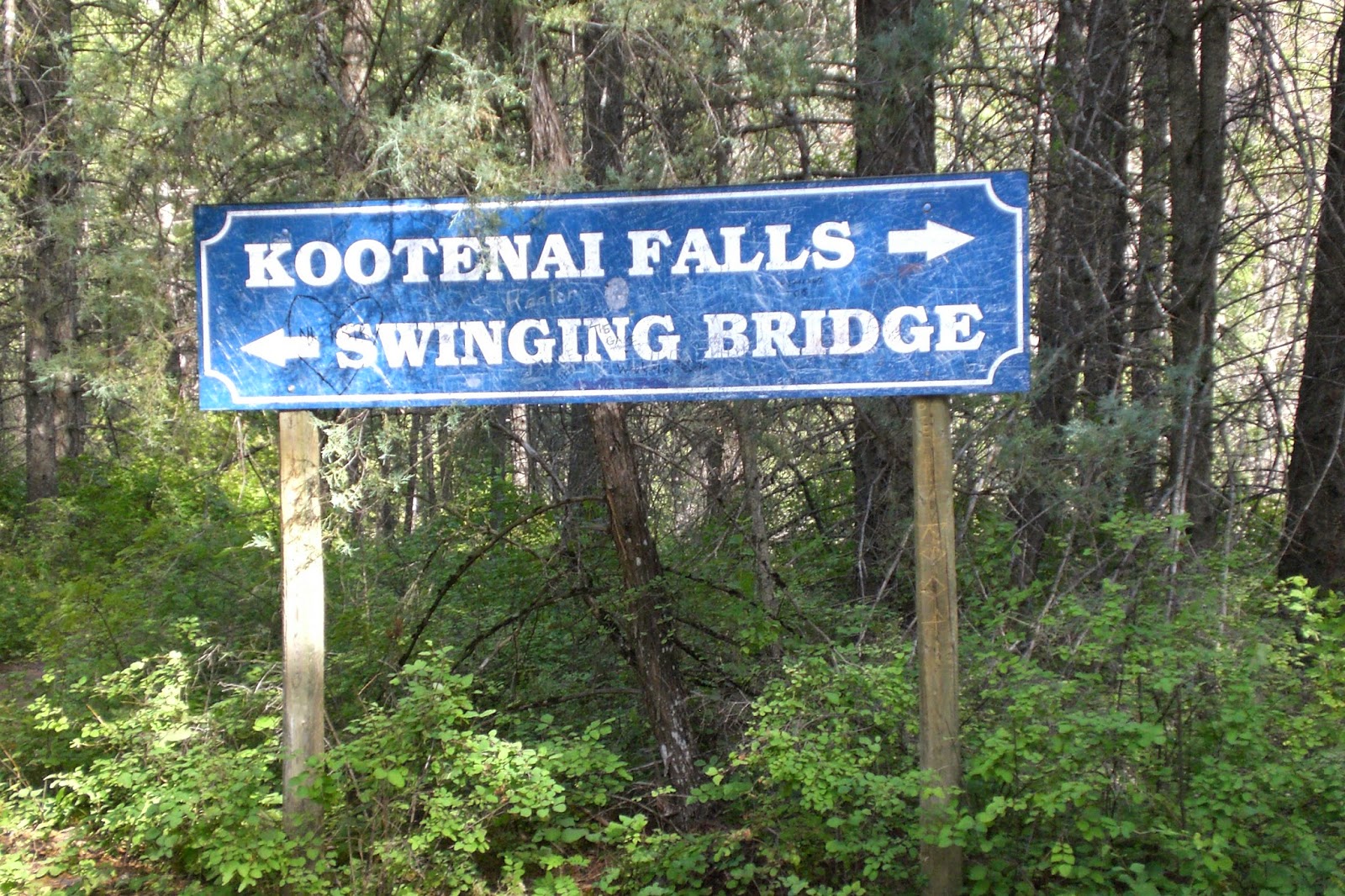
There comes a time when fear must be conquered, when it is time to face the nemesis of our mind, or in my case, the extremely physical barrier between an open bridge and the possibility of what may or may not be my demise beneath it.  The time to embrace my phobia came with a simple logic, “Did I come all this way to see this and then I am not going to enjoy it simply because it terrifies me?”  In the past, I might have easily answered my own question affirmatively, but here in the Kootenai National Forest, stretched across the identically named river and its cascading waterfalls, also so named, no one would know if I braved the crossing or merely looked at the scenery from the safety of the river’s bank.  The only way to know if I successfully cross this narrow, shaky span would be if I document the moment and prove I am embracing my inner crazy.

As I approach, a young couple who appears far less concerned  about the height and stability of the crossing receives a warm invitation to precede me across the bridge.  With only a few narrow boards of width, should I abandon the safe harbor of the river bank out towards its center, the two would have no ability to return to their starting point if I hesitate in my journey from the left bank to the right.  I eventually release my grip and venture out beyond a secure distance, so if they do reappear, I must rush forward or retreat.   As I progress on my uneasy crossing, I find my eagerness barely nudging me ahead, yet off they go, leaving the span bouncing over the cold rapids, and me to face my phobia.  I know somewhere inside I have the courage to ease my way away from the bank’s safe edge, and I eventually swallow and walk boldly to the center without stopping.  The young couple have long since left me alone on the wooden planks and I reach into my pocket and withdraw my camera (its strap clasped tightly around my wrist) to document and prove to the world what I have already proven to myself: I triumph over acrophobia.

Tuesday, November 11, 2014

A Taste of Alaskan

Brewery Bound

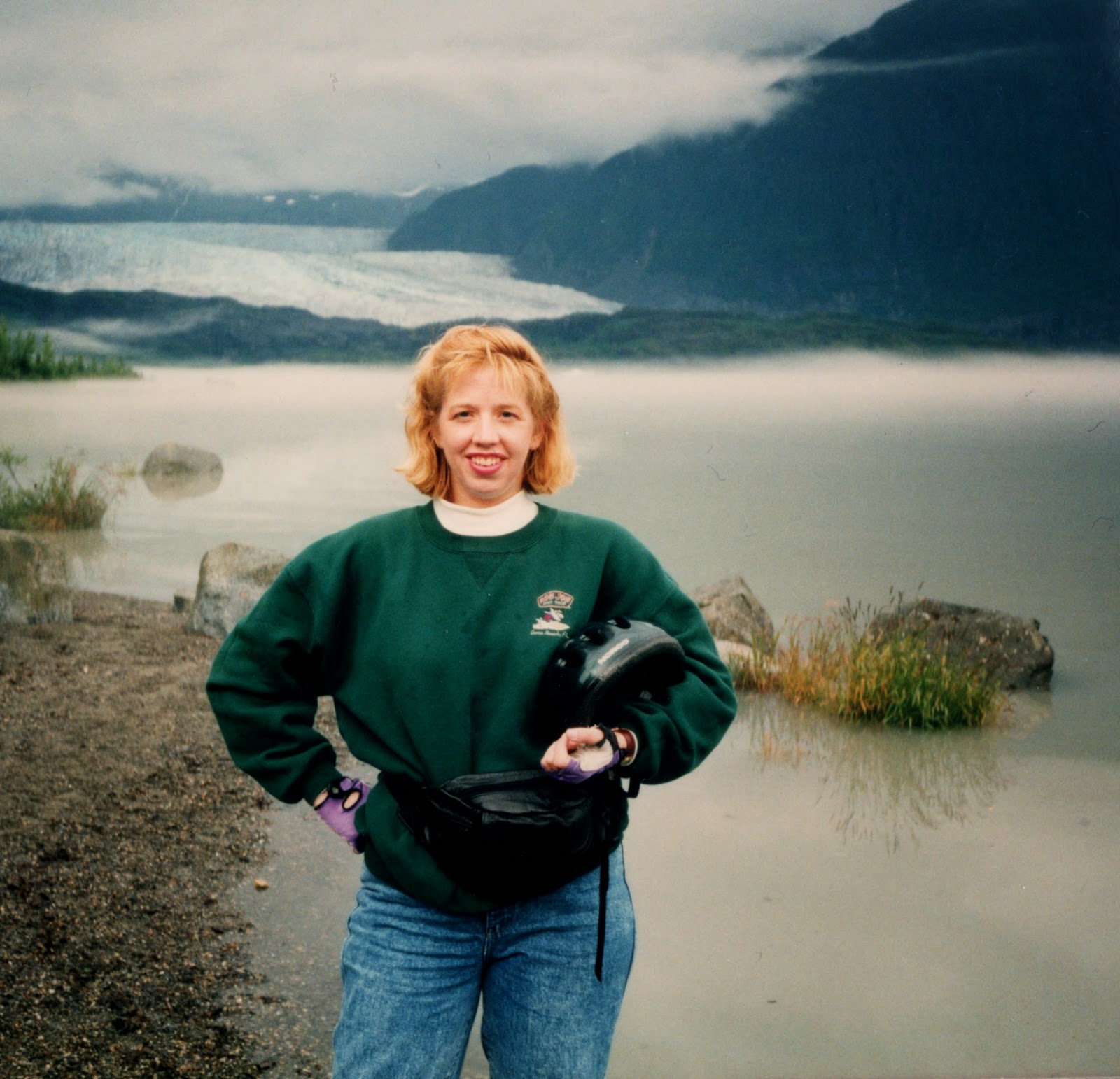
During my first voyage to Alaska, I partook in an activity I rarely experienced in my corner of the world: bicycle riding.  Admittedly, I experienced a wealth of activities in Alaska that eluded me in my southern lifestyle, but pedaling through the state capital rejuvenated me and reminded me of my capabilities when I push beyond my comfort zone.  To top off the sights, sounds, and sensations, we ride to the local brewery for a sampling of the fare, and when back aboard ship, I order a bottle to remind me of the brilliance of the day.

Fast forward fifteen years and I find myself again on two wheels pedaling my way through Alaska.  So much has changed in a decade and a half: Mendenhall Glacier receded deeply, my skills on two wheels floundered, and my favorite brewery changed locations.  Nonetheless, I keep cycling knowing the end of the journey brings me to the delightful tastes of Alaskan Brewery.  New seasonal tastes accompany and enliven my encore visit and I am reminded how much I enjoy the tastes that a distance of 3,248 miles enhances.  And although the adage sometimes rings true that one can never go back, I did, and deliciousness ensued.

Saying Goodbye to Summer

I sit on my front porch tonight, surrounded by the remnants of the first snowfall of the season.  Mother Nature keeps her own calendar and unlike mine, she believes winter arrives more than a week before the official start of autumn.  Despite thinned blood, I face her head on and I prop up my feet on the edge of the front porch and bask in the waning sunlight and ignore the thirty-six degrees.  I will enjoy my last unofficial day of summer regardless of her parting gift.  Across the country students have been back in school, some for nearly a month, but I make enchantment in the Bighorn Mountains of Wyoming as long as the season will allow.  But the foot-plus glistening white blanket Mother Nature cloaked over the ground yesterday signals the end of a glorious summer in this spectacular setting.

Melancholy moments such as this one challenge me not dwell wistfully on the time that passes, but to appreciate every day, every sunset, every excursion, every wildlife sighting, and every twinkle of the night sky that I have enjoyed.  The grandest highlights and the quietest periods of reflection combine into a summer full of memories to rival a lifetime of travel.  My summer home, my quirky cabin, my vast mountains, and my porch view surround me.  My skin tingles from the cold air.  The smell of the forest accompanies each inhalation.  A foraging squirrel squeaks out his success in acquiring a stash of pine nuts for the winter.  And to my right, the final sunset of my summer fades brilliantly behind the bank of trees.  My senses savor these fading hours, and I cap off the farewell to summer with the last bottle of beer in my refrigerator: Alaskan Summer Kölsch-Style Ale.  Summer never tasted so sweet.

Thursday, November 6, 2014

The Mystery Of Sage

Sense of Sage

When it comes to clothes, I rarely shop on the Internet, in fact, I never shop on the Internet.  If I received a one-hundred-percent assurance that my size would be reflected accurately in a single size that never changed from one style to another, if I knew with certainty that every designer used the exact same numbering system for my waist, bust, and hip sizes, if I could imagine effectively that the fabric would feel as soft, or sturdy, or smooth as I imagine it does on my screen, and if each item of clothes would appear as identically flattering when I lift it out of a cardboard box as it does on the web model, I might reconsider my choice to purchase every article of clothing I own only after evaluating its true appearance in a long mirror inside a dressing room previously occupied by equally intrepid online consumers.  And, of course, if I had any idea what color “sage” really looked like in person, rather than the various shades it encompasses on the worldwide web, then I might, just maybe reconsider online shopping.  But I doubt it.

Sage bumps into this same challenge in a variety of areas.  If you wanted to paint a wall in the earthy tone of sage, what would that sample look like from brand to brand?  If you added sage to a recipe, how much would you add, and would sage leaves taste different than ground sage.  Is the sage fresh, or has it been in a spice rack since the 1970s?  If you drive through the desert or cruise through the mountains, does sage even look like the same plant?  Darn it, sage, you are just too challenging to nail down – I just don’t know where you stand in nature, in the hardware store, in my kitchen, or in my wardrobe.

Smell of Sage

Mono Lake, nestled east of the Sierra Nevada Mountains on the eastern edge of California, feels less like a mountainous retreat and appears more like an aquatic dump.  Its environment and habitat hide a wealth of diverse plant and animal life, but unable to drain into another water connection, the salt content exceeds levels in many western waterways.  When I roll down my car window as I drive around its western edge, I expect an ocean aroma, but instead the fragrance baffles me with its sweetness.  As I continue around its southern exposure, I expect perhaps a change in the wind direction might lift its salty residue into the air, and yet the smells bombarding my nose confuse me.

When I finally pull off the road and take a closer look, or a deeper, unobstructed whiff, I find the culprit in this confusing sensual overload: sage.  The desert plant, while not in bloom, covers the low, dry hillsides beyond the water’s edge and for miles into Nevada and onward toward the east.  Nearly overpowering in its richness, the smell tantalizes me, and now that I am surrounded by the growth, I continue to breathe as deeply as possible, attempting to ingest as much of the aroma into my memory as into my lungs.  And with much success, I continue to recognize the sweet smell of sage years into the future, despite its nuances from the Great Basin into the high ridges of the Rocky Mountains.  Describing it in words, online, lacks the full enjoyment of its effects, the way it lifts above its stubby branches, the way it infuses the air and envelopes the wind, and the way it feels inside and around my being.  Yes, you just cannot understand sage on the Internet; you have to experience it in person.

Friday, October 31, 2014

Baltimore Nevermore

Downtown Baltimore

Notoriously, I swoop into a place with only an hour or two to enjoy the scenery, the historic site, or, in the case of downtown Baltimore, the snippet of literary history.  Except on this occasion, I allowed myself a lengthy twenty minutes to track down an extra added bonus to the weekend’s Civil War / War of 1812 excursion.  After a drive through Harper’s Ferry and around the Antietam Battlefield, then an entire day combing Gettysburg’s historic sites, and a full scale tourist assault around Fort McHenry, why not squeeze in one more site in the whirlwind view of the nineteenth century mid-Atlantic states?  Into the heart of the city I am ushered.

Upon dropping coins into the meter, a well-meaning, yet somewhat verbally irritated Baltimorean, pointed out to us, repeatedly, that at four o’clock the tow trucks begin sweeping the one-way corridors of the Charm City and our little rental would disappear.  I smiled, thanked her, and proceeded on to my destination somewhere in general vicinity where I had parked.  She may not have realized I possessed a knack for historic fly-bys; what I did not realize was that my parallel parking prowess on the corner of Fayette Street and Greene Street placed my exactly where I wanted to be.  She need worry nevermore.

Grave Hunting

Edgar Allen Poe, one of the quirkiest and most peculiar American authors (thus my interest in the site revealed), lies in repose on the grounds of Westminster Cemetery and in the short span of time between the quarters clanging in the metal meter and the tow truck hoisting its cables, I scurry about the grounds in search of the marker, and around the first corner, I poetically stumble into the author’s sanctum.  The literary fates, as well as the travel fates, shine their eyes upon my excursion.  Within fifteen minutes I return to my automobile before the regional wreckers have a chance to even glance in my tell-tale direction.

While not the first time I have visited a gravesite for the express opportunity to snap a photo and muse about the cultural curiosity the spot holds for me (see “Moonlight in Minnesota” from September 2013), the master of macabre seems appropriately placed here in the center of a city.  His contributions to American literature continue to reach the masses and almost all high school students find his name on their required reading lists.  Much like A Visit from Saint Nicholas has become a staple on Christmas Eve, Poe's nearly one-and-three-quarter-century-year-old poem should be worth at least as much time on an equitable holiday as the brief window I spend descending on downtown Baltimore in quest of his memorial.  If you’ve never read The Raven, please do so this Hallow’s Eve for the love of God, Montresor.

Wednesday, September 10, 2014

100 Miles And A Couple Centuries

Last of The Mohicans

If Daniel Day Lewis is not in your “Top Five” list, he most certainly will be after watching this film based on James Fenimore Cooper’s classic tale of life on the American frontier.  In Cooper’s time, the frontier stretched all the way into upstate New York and democracy still remained a vision to be scribed, much less lived.  Nonetheless, Lewis’ portrayal aptly created an impression of life in the colonies during the French and Indian War, when the spattering of cities and the frontiersman beyond their reach still aligned with the crown and an actor in leather could make any British daughter (and most any female viewer) swoon.  If anyone ever told me, “Stay alive; I will find you,” with such passion, I would readily obey.  If Daniel Day Lewis instructed me accordingly, I would develop successful cryogenics technology to enable such a possibility.

Nonetheless, the plot of Last of the Mohicans revolved around the idea of doing what is law versus doing what is right.  And as each character chose between each option, the story unfolds in a breathtaking setting, albeit cinematically altered, to give the impression that the uppermost British colonies on the North American continent offered vistas lost to the time of nobility, gentry, gallantry, romance, and heroism.  Those were most assuredly days long gone, in scenery transformed over two and a half centuries, but a click of the DVD player brings them, and brings Lewis fabulously back to my living room.
 
Lake George
 
With a toddler and a first-grader in tow, I cruise upward from Albany into the lush mountains of eastern New York.  We barely set foot inside the expanses of the Adirondacks when we begin our climb up to the hundred-mile view.  Not as imposing as the Bitterroot Mountains (see “The Rivers of Idaho,” December 2011), these peaks stretching down into Saratoga horse country and up just below the border with Quebec characterize much of the contrast between the state’s most renowned escapes and the state’s most renowned city.  The Adirondacks, while a focus of tourism yet without the skyscrapers of the city, still offers views far above the highway, gazing across the lakes and rivers, peering into Vermont on a tranquil, clear autumn afternoon.
 
Son Number One knows the basic highlights of American history at age eight and Son Number Two knows the basics of human communication as he approaches age two, yet they both sit quietly, enjoying the solemnity of the scene.  Below them on the shores of Lake George, more than two hundred years before their birth, a band of state militia fought to defend Fort William Henry from the threats of the French guns.  On where now exists little more than a souvenir stand, the characters from Last of the Mohicans paraded in a formal surrender before the French have the delight of burning the structure to the ground.  Here at this site, two boys sit quietly, sit closely, and sit patiently as their mother enjoys the history of this place, the tranquility of the view, and perhaps a wistful thought to Daniel Day Lewis’s portrayal of the something historically memorable, not to mention visually yummy.

Wednesday, August 27, 2014

Honey

Six Horses

Lately my travels have included a new and unusual term: tardy.  Of course, recent excursions have also included a series of new concepts: impetuousness, spontaneity, and broadening (as in my horizons), even more than my past adventures.  I have given up the luxuries of convenient motels and cozy beds and have experienced camping in its most basic form.  Admittedly, the tent in my back seat should provide adequate shelter for this new phase of my travels, but due in large part to my tardiness (and impetuousness, and spontaneity), I arrive at my campsite after twilight and discover the scenes to be too dark to pop my tent without making a disaster of my campsite or a nuisance to my adjoining overnight neighbors.  So by default, I have spent each night at my intended tent sites as the occupant of the folded-down seats of my SUV.  Delano, my affectionate mode of transportation, offers a hard surface, but a half dozen blankets, an air mattress, and a couple feather pillows make even a stormy night an exceptional, restful experience.

On one occasion, I reminded myself that time was of the essence in reaching my campsite to allow for adequate assembly of my tent.  Wavering between my driver’s-side window and my windshield, the sun swayed from front to side as the road twisted and curved and in the back of the car, the sack containing my tent begged at long last to gaze upward at the night sky.  Yet as I rounded a bend on County Road 585, I saw ahead on my starboard side five tall, brown horses galloping intently over the next rise.  Were they charging the length of the fence or towards the rails paralleling the road?  The angle of the road masked their true direction.  As soon as I topped the next hill, I saw the quintet stopped at the fence line, gazing longingly across the road to the corralled field on my right.  There a single gray horse sauntered towards the neighboring rail as if to tease the five stallions and greet their anxious impatience on the opposite side.  I wanted to pause for five or ten minutes to take photos, including a panoramic shot of the two contrasting scenes reminiscent of ladies’ night on the farm, but the clock was ticking, the tent was anxious, the campsite remained more than thirty miles away, and the sun was descending.  The equine meat market remained a memory.

For Sale

Pressing onward, a casual, yellow, hand-painted sign states simply, “Honey for Sale.”  I used the last of my supply only days before and how convenient that I would receive a shopping-list reminder late on a Sunday evening.  But at this hour, the vendor would have retreated for the night.  To my absolute delight, the marketplace remains open, yet unattended.  Making a u-turn, I double back to the wooden structure featuring a bevy of sweet selections.  Buckets and bottles and bears offer a range of sizes and samplings.  A box of free honey recipes adds a personal touch to the fare.  A single metal tin – a leftover from a holiday cookie exchange of many years ago based on its wear – sits simply on a shelf, waiting to be opened by a random passerby.  I try not to spill its contents and I discover nearly twenty dollars worth of previous purchases, and a notepad for a brief comment to the unknown merchant.  I deposit my five spot, scribe a note of appreciation, sign my name and the date, and snag a bottle of Devil’s Tower Honey.

On small country roads, in the corners of Wyoming [or Maine, but that was a matter of firewood], a commodity sits safely curbside.  I am equally delighted by the presence of honey in this vast openness on its own rustic shelves and by the confidence, trust, and sincerity of the vendor.  On a swath of hilly road, a selection of merchandise, a small deposit of cash, and an offer for preparation tips of the treat greet a complete stranger like me.  Trust abounds.  Transactions occur.  The wind blows in the otherwise silent store.  A pound of Wyoming sweetness travels away from its home and in Delano’s possession.  Of all my souvenirs from this outing, a simple jar of honey may be my favorite.  My tent cringes as it realizes it will spend another night unassembled in its sack because the impetuous purchase of my sweet tooth, the spontaneity generated by a simple yellow sign, and my continued broadening of my horizon by taking the road less traveled all take precedence over the sun’s position in relationship to its own horizon.  As I finish my exchange with the wooden box, a van also succumbs to the sweetness and sincerity of selection.  We exchange salutations, and I know another jar of Devil’s Tower Honey will grace the table of a random traveler, and the pot of trust will grow.